Avicenna Mausoleum, also known as the Ibn Sina Tomb, is an important landmark in Hamedan as a dedication to Abu Ali al-Husayn ibn Sina (Avicenna). He was the most famous polymath, whose contributions went to the fields of medicine and philosophy, among others.
Abu Ali Sina (980-1037 CE) wrote over 400 works, of which The Canon of Medicine had a far-reaching influence on the practice of medicine up to the 18th century. Nowadays, the mausoleum is a historical site, cherished in Iran and is visited by a large number of people who wish to pay homage to the intellectual heritage of Avicenna.
What is it that makes the tomb of Avicenna an enduring symbol of universal knowledge? Keep reading to find out about its intriguing past, extraordinary architecture, key sections and other information to visit this architectural gem of Hamedan.
Who Was Avicenna?
Abu Ali al-Husayn ibn Abdullah ibn Sina, who is referred to as Avicenna in the West, was born in 980 CE in the vicinity of Bukhara (modern-day Uzbekistan) and spent a great part of his life in Hamedan. He made the greatest impact through his remarkable writings, particularly The Canon of Medicine (Al-Qanun fi al-Tibb) and The Book of Healing (Kitab al-Shifa).
They remained as principal textbooks in the Islamic civilization and Europe for centuries. The Canon was the only book used in the teaching of medicine in the universities of Europe until the 17th century.
This remarkable Avicenna biography reveals why Iran honors him so greatly: his influence was so huge that he was considered the chief representative of the scientific revolution in the East. Thus, the Mausoleum of Avicenna has become a landmark of Persian culture.
History of Avicenna Mausoleum
Avicenna passed away in Hamedan in 1037 CE and initially had a simple grave as his resting place. The present-day mausoleum of Avicenna was erected between 1947 and 1954, under the order of Reza Shah Pahlavi, who wanted to commemorate the millennium of Avicenna’s birth.
The design of the complex took inspiration from the Gonbad-e Qabus tower and the spirit of the Sassanid era, but was executed in a modern-Iranian style. The city of Hamedan was chosen as Avicenna spent his last years there as vizier and doctor.
The Avicenna Tomb is now considered one of the main elements of the city’s cultural identity as it symbolizes both ancient knowledge and 20th-century Iranian architectural glory.
Architecture and Design of the Tomb of Avicenna
The Avicenna Mausoleum is an excellent example of how ancient Persian motifs can be perfectly combined with modern design. The use of white travertine stone, along with clean lines, geometric precision and light, gives it a soothing but strong atmosphere. By looking at the Mausoleum of Avicenna photos, you can truly realize the stunning architecture that rewards visitors.
The 12-Sided Tower of the Tomb
The tower’s height of 28.5 meters, which is extremely awesome, is sustained by the twelve slender and fragile vertical ribs that converge at the apex of the cone. These ribs symbolize both the twelve centuries from Avicenna’s birth to the time of construction and the twelve disciplines he mastered.
The base of the Avicenna Mausoleum, having a polygonal shape, is a reminder of the pre-Islamic Persian towers, whereas the overall minimalist approach gives it a very modern look indeed. Beneath the tower lies the underground crypt, where Avicenna’s sarcophagus rests along with that of his friend and assistant Abu Sa’id.
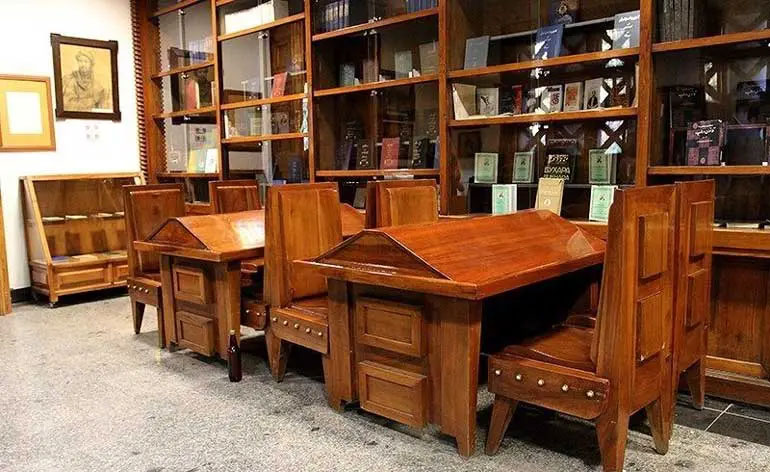
The Library
In the northern wing, a research library of a special kind is situated, which contains over 9,500 volumes. The library includes the Canon’s rare manuscripts in Arabic, Persian and Latin, early printed editions from Venice and Rome, and later scholars’ commentaries. Silent reading halls are open to the researchers all the time.
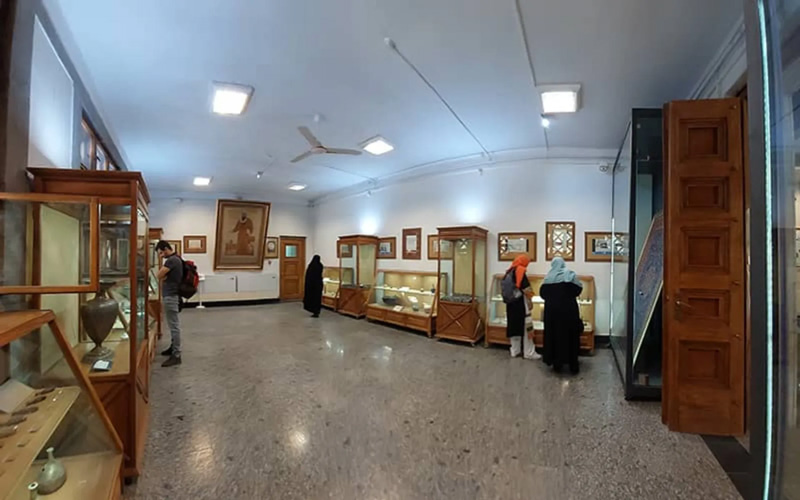
The Museum Inside the Compound
The southern wing of the building houses a small but very interesting museum. Among the exhibits are bronze surgical tools from the Islamic Golden Age, pages of a manuscript illustrated by the hand of a famous artist showing Avicenna teaching students, coins made with his image as a token of respect, and the arrangement of his study with his writing desk and astrolabe.
Besides that, there are multilingual panels and short documentary film screenings about the Avicenna Mausoleum, making the visit even more interesting.
Make your arrival stress-free by booking a trusted Iran airport transfer in advance. Take part in our guided tours to the Tomb of Avicenna, providing you a nice visit with a deeper understanding of the tomb’s history and architecture.
—Create lasting memories while exploring ancient Persia through our Iran Budget Tours.
Location and How to Get There
The Avicenna Mausoleum is the main attraction in Hamedan; it is situated right at the heart of Bu Ali Sina Square (or Ibn Sina Square), which is one of the most popular places in the city. No matter where you are in town, just say “Bu Ali Square” or “Tomb of Avicenna” – all taxi drivers are aware of it.
Public transport, like buses and taxis, heading towards the city center stops just a few minutes’ walk from the hotel. The complex is just 1.5 km from the historic bazaar and 2 km from the famous Ganjnameh inscriptions.
Address: Bu Ali Sina Square, Hamedan, Iran.
Make these views a reality by completing your Iran visa application today.
Last word
The Tomb of Avicenna in Hamedan is a testament to the enduring legacy of one of the greatest thinkers of the Islamic Golden Age. The tomb is a beautiful example of traditional Iranian architecture and it provides a peaceful place for visitors to reflect on the life and legacy of Avicenna. The city of Hamedan itself is also a fascinating destination for anyone interested in history, culture, and philosophy. With its rich heritage and welcoming atmosphere, Hamedan is a must-visit destination for anyone traveling to Iran.
With our Iran Tour Packages, you’ll walk through ancient bazaars, marvel at majestic mosques, and uncover the timeless beauty of Iran.
Let us know your ideas and comments about this tomb in the comment box below, we will be happy to hear from you!