At the heart of the busy Shiraz city, the Arg of Karim Khan stands as a majestic reminder of the Zand dynasty’s 18th-century glory. This fortress was constructed as the royal residence of Karim Khan Zand, cementing its position in Shiraz as the Iranian capital during his reign between 1751 and 1779.
The Arg Karim Khan, Shiraz, has masterfully combined military defense with luxury living. Its great walls and lavish interiors captured Karim Khan’s vision of a thriving, cultural heartland. Read further to discover the history, unique architecture and the visitor reviews of the site.
History of Arg of Karim Khan
The Arg of Karim Khan, or Karim Khan Citadel, originated during the chaotic 18th century after the collapse of the Safavid kingdom. The assassination of Nader Shah in 1747 left a power void that was filled by Karim Khan Zand, who united his rivals and declared Shiraz the capital city in 1762.
In circa 1766, he ordered construction of the citadel in a large complex consisting of bazaars, mosques and lush gardens. It is located in the Northwest of the former city to reinvigorate trade and community.
The Arg of Karim Khan Zand was Karim Khan’s place of residence, which reflects his modest title of “Vakil al-Ro’aya”. Qajar troops captured Shiraz in 1794, following the death of Karim Khan, using it as a garrison.
It was a harsh prison for dissidents in the 19th century until the year 1979. Nowadays, it is restored and named the “Pars Museum”, housing Zand artifacts, showing the transition from a luxurious house to an army base and beyond.
Arg-e Karim Khan Construction Date
The Arg-e Karim Khan Shiraz was built between 1766-1767 CE (1180 AH), which was an efficient two-year construction. Individual architects are undocumented, but it was directed by Zand-era craftsmen, embodying the Zand style.
This style combined Safavid elegance and useful innovations, where the emphasis was on balance, light and eco-friendly elements like qanats. It was based on Isfahan precedents but adapted for local conditions to construct a sustainable, yet imposing building.
Role during Zand Dynasty
The Zand dynasty saw the political and administrative center of Shiraz located at the Arg of Karim Khan Zand. The citadel was the main residence of Karim Khan, who was considered to be very just and a military leader. The fortress accommodated royal courts, the administrative offices and residential quarters, which represented the authority of the ruler as well as provided security to the city.
Changes under Qajar and Pahlavi Dynasties
The changes in the argument of Karim Khan of Shiraz occurred after the collapse of the Zand dynasty. During the Qajar rule (1789-1925), the citadel became a residence of a governor, and then a prison and lost its royal status. However, the historical value came to be neglected during the Pahlavi era (1925-1979), although some attempts were undertaken to maintain its historical value.
Karim Khan Biography
Karim Khan Zand, born around 1705 in the Lak tribe of Luristan, rose to prominence through military prowess during the downfall of Nader Shah. By the year 1751, he was a wise ruler who promoted justice, tolerance between religions and prosperity. He chose Shiraz for its fertile valleys and caravan paths and titled it “Dar al-Momenin.”
Karim Khan’s urban legacy shines in the Persian city of Shiraz. Besides the Arg of Karim Khan, he built the Vakil Bazaar for trade, the Vakil Mosque for worship and Saraye Moshir as a merchant’s haven.
These buildings were characterized by intricate tilework, large iwans and thoughtful designs that combined beauty with daily use. His death marked the beginning of a decline of the Zand dynasty, but his just rule and the consequent development of Shiraz as the poetic capital of Iran remained.
—Make unforgettable memories with our Iran Budget Tours, the perfect blend of comfort and affordability.
Architecture of Arg of Karim Khan, Shiraz
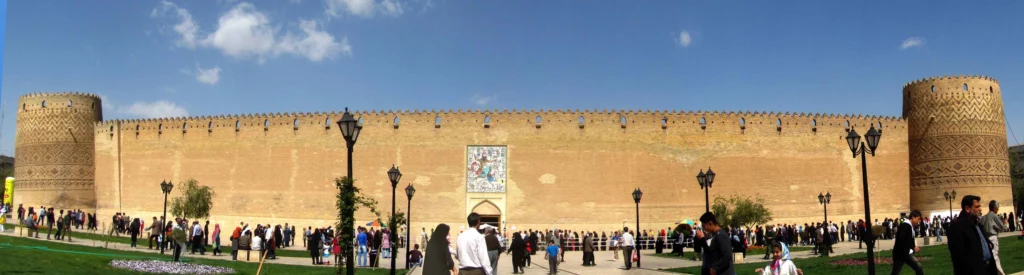
The Arg of Karim Khan Shiraz, which spans an area of 10,000 square meters, is a rectangular-shaped structure with walls 14 meters high surrounding a tranquil central garden. The corners of the building are protected by four strong cylindrical towers that are 14 meters high with battlements.
The once-watered moat enhanced security via underground channels, while ornate entrances made all sides beautiful. The builders employed sun-dried bricks for their strength, gypsum plaster for their invisible surfaces and cooling effect, and cedar wood for their solid frames.
The interior, which consists of two floors, has storage and stables on the ground floor and private areas upstairs. The arches of the iwans in the courtyard overlook them, and the muqarnas stalactites and delicate floral paintings adorn them.
The traditional bathhouse consists of domed ceilings and marble pools; the seasonal rooms are equipped with natural airflow and fireplaces for comfort.
Arg-e Karim Khan Leaning Tower Southeast
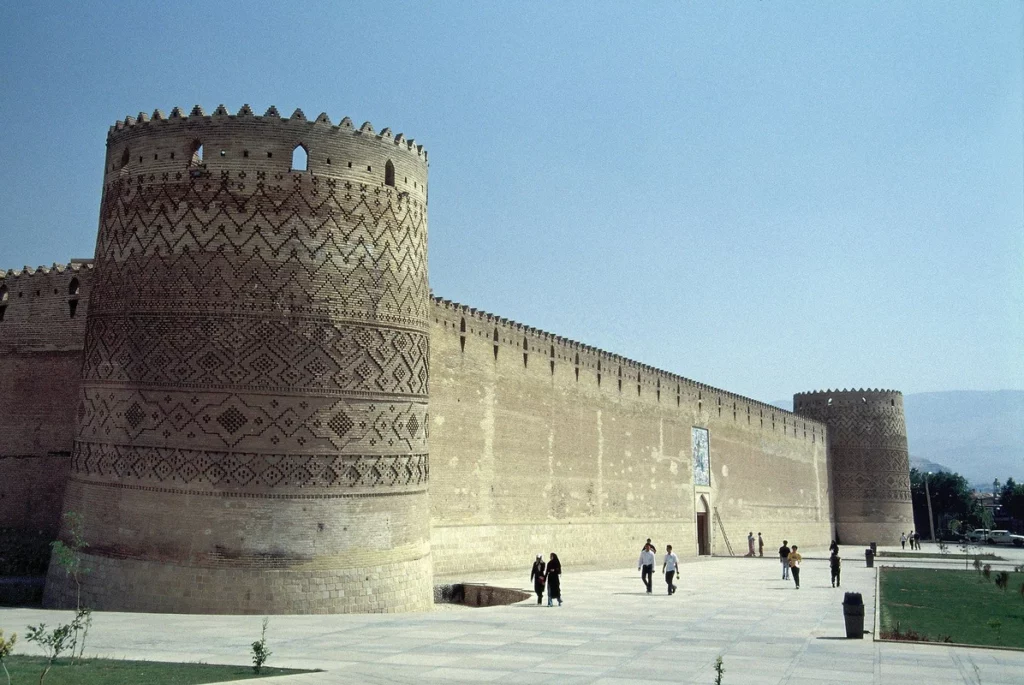
The surprising 8 degrees eastward inclination of the southeast tower has turned it into a tourist attraction, which has been compared to a Persian Pisa. It was soil subsidence in Shiraz’s soft ground and the collapse of the qanat system that initially caused the problem, which then worsened through erosion and earthquakes.
The tilt was already remarked upon in the 1800s; however, in the 1970’s there was a reinforcement done that safeguarded it, thus turning the quirk into a highlight for photos and the telling of resilience stories.
Façade and Exterior Towers
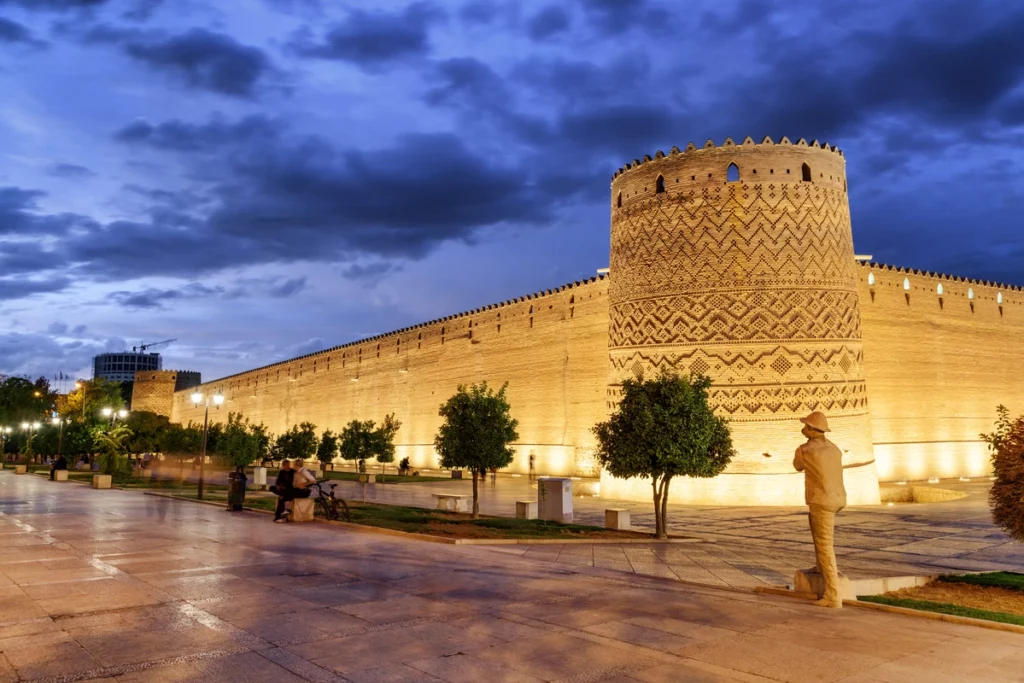
The outer appearance of the Karim Khan Citadel is characterized by huge brick-and-plaster walls, 14 meters high and covered with elaborate tilework, illustrating the Persian epic hero, Rostam. The corners are anchored on four towering cylindrical structures, one of which is deliberately leaning over to produce a unique look. These are defensive towers that enhance the aspect of the fortress.
Courtyard and Interior Layout
Indoors, the Karim Khan Citadel features a central courtyard with lush gardens and fine arches. The structure is built in such a way that it uses natural light and air conditioning with rooms facing the courtyard so that they are easily accessible and comfortable. It has bright color painting and elaborate knotwork on its interiors, which is typical of Persian art.
Our Iran Tour Packages take you beyond the guidebooks — offering exclusive access to cultural treasures, hidden spots, and the true heart of Iran.

Karim Khan Citadel Bath (Hammam)
The Karim Khan Citadel Bath and/or hammam is a constituent of the complex, as the Zand dynasty also believed in personal cleanliness and interaction with others. The bathhouse featured elaborate tilework and vaulted ceilings that were used by royalty and dignitaries. It is now an exhibit of the traditional Persian bathing culture and architectural beauty at a museum.
Cultural and Historical Significance of Arg of Karim Khan Zand
The Arg of Karim Khan Zand is a symbol of power and vision of Karim Khan, who wanted to produce a prosperous and righteous Persia. Being the political and cultural center of Shiraz, it was a venue of major events and cultural and intellectual cross-fertilization of the Zand dynasty.
Use as a Prison during Later Periods
The citadel was turned into a prison during the Qajar rule, which was a great contrast to the way the citadel was used as the royal residence. This was the time when its prestige went down, with some of its parts being in ruins. Nevertheless, it did not lose its historical importance.
Today’s Role as a Tourist Attraction and Museum
The Karim Khan Citadel in Shiraz is a lively tourist spot and cultural center these days. It is home to museums and exhibitions, which make it attractive to visitors who can learn about the history and architecture of the building. Its attractiveness is also promoted by cultural events, e.g., handicraft exhibitions and traditional performances.
Museum and Exhibits at Karim Khan Citadel
The museums of the citadel display various artifacts, such as manuscripts of the Zand period, historical monuments, and decorations. The Arg of Karim Khan is an active cultural hub, and the visitors can find exhibits on Persian art, architecture and history and seasonal cultural events underline the rich traditions of Shiraz.
Visitor Information: Karim Khan Citadel Shiraz
Here is some information for those who want to visit the Karim Khan Citadel:
Location and Access Routes
Karim Khan Citadel is a historical site in the center of Shiraz, close to Shohada Square. It can be reached readily by taxi, bus or foot via other attractions around like the Vakil Bazaar. An airport transfer in Iran can be booked to facilitate a smooth entry into Shiraz.
Opening Hours and Entry Fee
The Arg of Karim Khan is available every day beginning from 8:00 AM to 8:00 PM and also on extended hours during the high tourist seasons. Foreigners need to pay about 5 USD for the entry fee, which can vary. See the latest information on irun2iran.com.
Best Visiting Time
The best season of the year to visit is between October and May, when the weather is pleasant in Shiraz. The season of spring (March-May) is especially captivating and the flowering gardens make the citadel more charming. Being early will help you avoid crowds of visitors, particularly during busy seasons.
Photography Tips
The use of photography is allowed within Karim Khan Citadel, but tripods might need authorization. Take the pictures of the complicated tilework and colored windows in the morning to be the most productive. Guidelines put in place by the respect ensure the integrity of the site.
Nearby Attractions
The citadel is encircled by the sightseeing spots, which are the Vakil Bazaar, a packed marketplace; the Vakil Mosque, with the gorgeous tile-work; and the Vakil Bathhouse, a historical hammam. These attractions provide a complete Shiraz experience.
If this sounds like your kind of destination, make sure your Iran visa application is ready before planning your trip.

Arg of Karim Khan Reviews
The Arg of Karim Khan reviews score 4.5/5 on TripAdvisor and Google, based on 400+ entries. The “peaceful courtyard sanctuary” and “historic murmurs” of the hammam are both highly praised by travelers. The interactive museum represents Zand’s daily life, which is particularly attractive for families, while the guides are a great support in the prison phase, making it easier for academics.
Typically, visits take 45 to 60 minutes, allowing for a short but fun experience. Most of the complaints involve the very few issues concerning frescoes restoration, crowding during peak hours and the floor not being very even, which has suggested morning visits as the best time.
The Arg of Karim Khan Zand is a must-visit place for those who love Iranian history and architecture. Make sure to book your trip to Shiraz with Irun2Iran and write your Arg of Karim Khan reviews to motivate other travelers!
Let us know your ideas and comments about this lake in the comment box below, we will be happy to hear from you!
leave a message on Whatsapp to contact us.
FAQs
When was the Karim Khan Citadel Built?
Karim Khan Citadel is another construction built in the 18th century during the rule of Karim Khan Zand (1751-1779), serving as a royal place and fortress.
What is inside the Arg of Karim Khan?
The Arg of Karim Khan has a central courtyard, a bathhouse, living quarters, beautiful gardens and museums that contain the artifacts of the Zand era.
What are the visiting hours and ticket fees?
The citadel operates from 8:00 AM to 8:00 PM. Entry fees are about 5 US Dollars for foreigners. Check with Irun2Iran beforehand.
Where is the Karim Khan Citadel located in Shiraz?
It is situated near the Shohada Square of central Shiraz, which is reached by bus, taxi or walking from some other nearby attractions, including the Vakil Bazaar.
What is special about the Karim Khan Citadel Bathhouse?
It has intricate tilework and vaulted ceilings, clearly showing the culture of bathing of the Zand era. It is now turned into a museum exhibit in the citadel.
Can tourists take photos inside the citadel?
Yes, you can take photos, but if you are planning to use tripods, make sure to gain permission first. The tiles and stained-glass windows of the citadel are best photographed in morning light.